Ask ten different property investors this question and you’ll probably get ten different answers. Residential or commercial? It’s one of those debates that never really settles, because honestly, it depends on your budget, what you’re trying to get out of the investment, how much risk keeps you up at night, and how long you’re willing to sit on the property before cashing out.
Here’s the rough shape of it though. Residential holds up because people need a roof over their head, plain and simple. That demand doesn’t really go away. Commercial can pay off bigger sometimes a lot bigger but only when it’s in the right spot. Wrong street, wrong neighborhood, and that upside evaporates pretty quickly.
Let’s get into both, and hopefully by the end you’ll have a clearer sense of which side you lean toward.
Residential property, in plain terms

This is the category most people already have some instinct for apartments, independent houses, villas, duplexes, plots, builder floors. It’s usually where first-time investors start, and there’s a good reason for that: it’s just easier to understand. You buy it, and then you either move in, rent it out, or let it sit and appreciate while you go about your life.
What actually drives demand isn’t some mystery either. More people moving into an area, more jobs nearby, decent schools and hospitals, transport links that don’t make your commute a nightmare that’s basically it.
Commercial property, in plain terms
Office spaces, retail shops, business centers, showrooms, the odd mixed-use building this is property built for businesses, not families. And look, the income potential here can be genuinely exciting. I’ve talked to people who swear by commercial for exactly that reason.
But and this is a big but it’s a lot less forgiving than residential. You can’t just eyeball the building and call it a day. You’ve got to actually think through who’s going to rent it, what the lease terms look like, how long it might sit empty if a tenant walks, and what you’re paying just to keep the lights on while you wait.
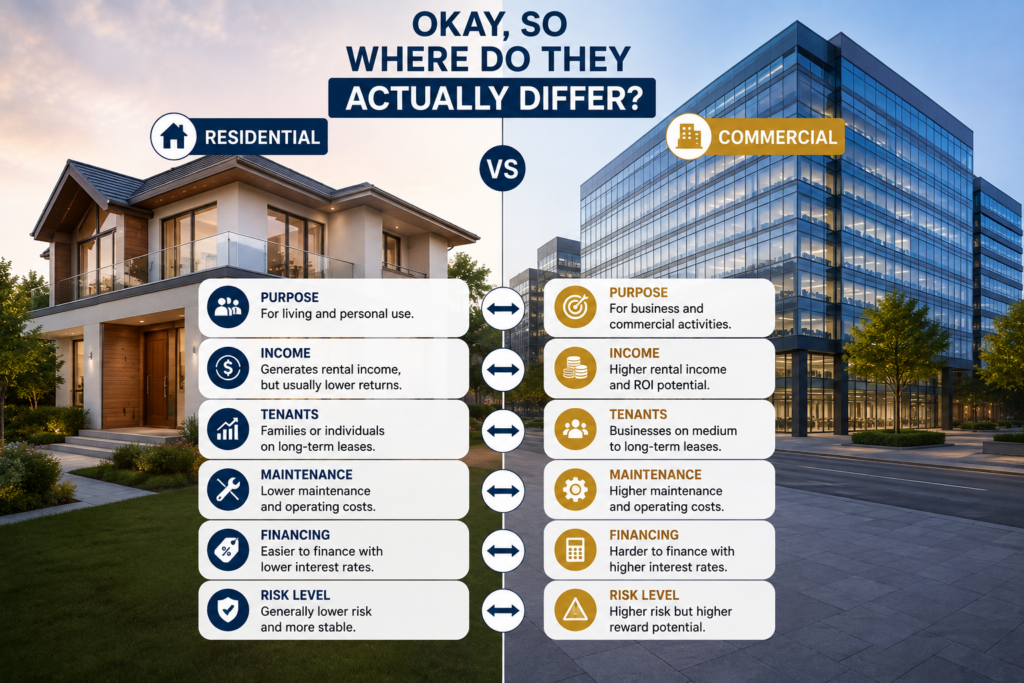
Okay, so where do they actually differ?
Money upfront
Residential tends to be more accessible there’s genuinely something at almost every price point. Commercial can ask for a lot more, depending on size and location and what kind of development it’s part of.
Except that’s not always true either. I’ve seen small commercial units go for less than some residential flats sitting in a fancy part of town. So don’t walk in assuming one category is cheaper by default that’s lazy thinking. Compare the actual listings in front of you.
Rental income
Probably the number one reason anyone gets into real estate. Residential rent tends to stay fairly predictable in areas where the population’s growing and jobs are within reach not flashy, but steady.
Commercial can pay more, relative to what you put in, but it swings hard depending on location. Get a good business tenant into a well-placed office or shop and you might land a lease that runs for years. Sounds ideal until you remember that higher potential rent almost always comes bundled with higher vacancy risk. There’s no free lunch here.
Who’s actually renting it
Residential wins this one pretty easily. Everyone needs somewhere to live that tenant pool is just wider. Commercial depends much more on what’s happening locally, business-wise. So before putting money down, it’s worth actually walking the area and checking:
- How many businesses are already operating nearby
- Foot traffic is anyone actually walking past?
- How easy it is to get to (parking counts more than people think)
- Public transport nearby
- The residential population around it they’re often the customer base
- How much competing commercial space is sitting empty nearby
- General economic pulse of the area
Nail the location and a commercial unit can genuinely perform. Miss it, and you could be stuck advertising for tenants for a long, long time.
Will it actually appreciate?
Both types can go up in value location decides most of it, not the property type. Areas near new infrastructure, metro lines, job centers, decent schools and hospitals tend to attract more buyers over time. Places like Noida, Greater Noida, and Ghaziabad have gotten a lot of attention lately because of ongoing development work there.
One thing worth saying clearly, though just because an area is “developing” doesn’t mean your specific property is guaranteed to appreciate. That’s a trap a lot of first-timers fall into. Do the actual research instead of riding the hype.
Risk and empty months
No investment is risk-free, obviously. Residential vacancies tend to be shorter when housing demand is strong in that area though rents can still bounce around a bit.
Commercial, when you land a solid tenant, can give you longer, steadier leases. But if that tenant leaves? Finding a replacement can take a while, especially for spaces built for a specific kind of business, or in markets that aren’t that active to begin with. You need to weigh both sides of that coin, not just the good months.
Upkeep and maintenance
Residential comes with the usual list leaky taps, repainting, electrical fixes, general wear. Commercial has its own version of this, but who actually pays for what depends heavily on the lease and how the building’s managed.
Before signing anything, get clear answers on who’s covering:
- General maintenance
- Common-area charges
- Repairs
- Utilities
- Property tax
- Security
- Facility management
These little costs add up fast, and they quietly eat into whatever return you thought you were getting.
Financing
Loan terms and eligibility can look pretty different between residential and commercial, and this varies bank to bank too don’t assume they’ll treat the two the same. Look past the monthly EMI and work out what the whole thing actually costs you over time. If we’re talking serious money, it’s worth getting a proper financial or legal opinion rather than winging it.
Location beats category, basically every time
If there’s one mistake I keep seeing, it’s people deciding “residential” or “commercial” before they’ve even looked hard at where the property actually is. A decent residential flat in a good spot can beat a mediocre commercial unit any day and the reverse is just as true.
Before you commit to anything, ask yourself:
- Is this area actually growing, or just talked about?
- Is infrastructure genuinely improving here?
- Who’s realistically going to buy or rent this and why?
- How accessible is it, really?
- What’s nearby businesses, homes, both?
- Where does this area realistically go in five or ten years?
Get these answers first. The residential-vs-commercial label matters a lot less than people think.
Residential probably makes sense if…
- This is your first time investing in property
- You like keeping the option of using it yourself someday
- You want access to a wider pool of possible tenants
- Your budget sits somewhere in the middle
- You’re comfortable playing the long game
- Personal use is part of the plan, even years down the line
There’s also more room to pick your poison here apartments, plots, independent houses, villas, duplexes plenty of ways to shape the strategy around what you actually want.
Commercial probably makes sense if…
- You can stomach a bigger check upfront
- Rental income is really what you’re chasing
- You already have some grip on how commercial markets move
- You’ve actually done the legwork on local business demand not just glanced at a brochure
- You can handle the possibility of a longer vacancy stretch
- You’re fine reading through leases and vetting tenants
- You’re in this for the long run, not a quick flip
One honest word of caution: don’t buy commercial just because the yield number on the listing looks good. Understand the actual market you’re stepping into first, or you’ll regret it.
A quick word on NHR Builder and Developer
Finding the right property usually takes more than scrolling listings at midnight. NHR Builder and Developer works across residential, commercial, luxury, and investment property, and helps out at different stages shortlisting properties, site visits, legal due diligence, negotiation, home-loan help, after-sales support, that kind of thing.
They’re active in Noida, Greater Noida, Ghaziabad, and Dubai, so there’s a reasonable spread depending on where you’re looking. Worth checking their website if you want to see what’s currently on offer.
So, which one’s right for you?
Depends what you’re actually after. If stability, broad demand, and a more straightforward path into real estate sound like your priorities residential is probably the safer bet to start with. If you’re chasing rental income and you’ve got both the capital and the market knowledge to handle the risk commercial’s worth a serious look.
Instead of asking “which one’s better,” try asking “which one’s better for me, right now.” That small shift tends to make the whole decision a lot less confusing.